
System Design for African Developers: Why It Matters in 2026
Africa is producing developers at an incredible pace. Today, an estimated 4.7 million developers work across the continent, making Africa one of the fastest-growing technology talent hubs in the world. On the surface, that sounds like great news, but there is a surprising contradiction emerging in the job market.
Despite the rapid growth in developer talent, companies are still struggling to hire experienced engineers. In 2025, 84% of large South African corporations reported difficulties filling highly skilled ICT positions, and the demand for senior technical talent continues to outpace supply.
So how can Africa be producing more developers than ever while companies still cannot find the people they need?
The answer is that the gap is no longer about quantity. It is about depth. Companies are increasingly looking for developers who can do more than write code. They need people who can design systems, make architectural decisions, think about scale, and build products that can grow alongside their users.
That is where system design comes in.
Many developers treat system design as an advanced topic reserved for staff engineers at large technology companies. In reality, it is one of the most valuable skills any developer can learn, regardless of whether they are building a startup, freelancing, or preparing for senior engineering roles.
So, what is system design anyway?
At its core, system design is the process of planning how a software system will work before you build it. It is about deciding how different components interact, how data moves through a system, and how an application will continue performing as more users begin to rely on it.
A lot of developers associate system design with senior engineers at big technology companies, but that is a misconception. Whether you are building an e-commerce platform, a banking application, a school management system, or even a personal project, you are already making system design decisions every day. The difference is that developers who understand system design make those decisions intentionally rather than accidentally.
System design forces you to ask questions that go beyond writing code.
How will this application perform when 10 users become 10,000?
How easy will it be to introduce new features six months from now?
What happens if one component fails?
How do we protect sensitive data?
In many ways, coding is building the house. System design is creating the blueprint.
Without a blueprint, even the most beautiful code eventually becomes difficult to manage.
The five qualities every well designed system should do
Whenever I'm building or reviewing a system, I always encourage developers to think about these five qualities.
1. Performance
Your application might work perfectly with 10 users. But what about 10,000 ?
performance determines how fast and efficiently an application responds under real-world conditions. Users rarely tolerate slow software, and poor performance often becomes one of the earliest signs that a system was not designed properly.
2. Maintainability
Can another developer understand your code six months from now?
Software is never truly finished, and developers will inevitably need to update, debug, and improve it over time. A maintainable system allows teams to make those changes without introducing unnecessary complexity.
3. Modifiability
Can you add new features without rewriting everything?
Modifiability refers to how easily a system can adapt to changing requirements. Businesses evolve quickly, and software that cannot evolve alongside them eventually becomes a liability.
4. Scalability
Can your system grow alongside your users?
Measures how effectively a system can handle increasing users, traffic, and data volumes without breaking down. A good design today shouldn't become tomorrow's bottleneck.
5. Security
How well does your application protect its users and their data?
As applications collect more sensitive information, protecting users and preventing unauthorized access becomes a foundational requirement rather than an optional feature
Remember, Security isn't something you add at the end it's something you design from the beginning.
These aren't "nice-to-have" qualities.
These are the characteristics companies pay senior engineers to think about every day.
The microservices debate: there is no perfect architecture
One of the biggest decisions developers make is choosing how an application will be structured. You have probably heard terms like monolithic architecture and microservices architecture thrown around during technical interviews or engineering discussions.
misconceptions among developers is believing there's a "best" architecture.
There isn't.
You'll often hear people say:
"Everything should be microservices."
That's not true.
A monolithic architecture keeps everything inside a single application. It is generally easier to build, deploy, and manage, especially for smaller teams or early-stage startups. However, as the application grows, it can become harder to scale and more difficult to modify without affecting other parts of the system.
Microservices, on the other hand, split an application into independent services that can be developed and deployed separately. This approach makes it easier to scale and isolate failures, but it also introduces additional complexity and operational overhead.
Here is a sided by side comparison of the two:
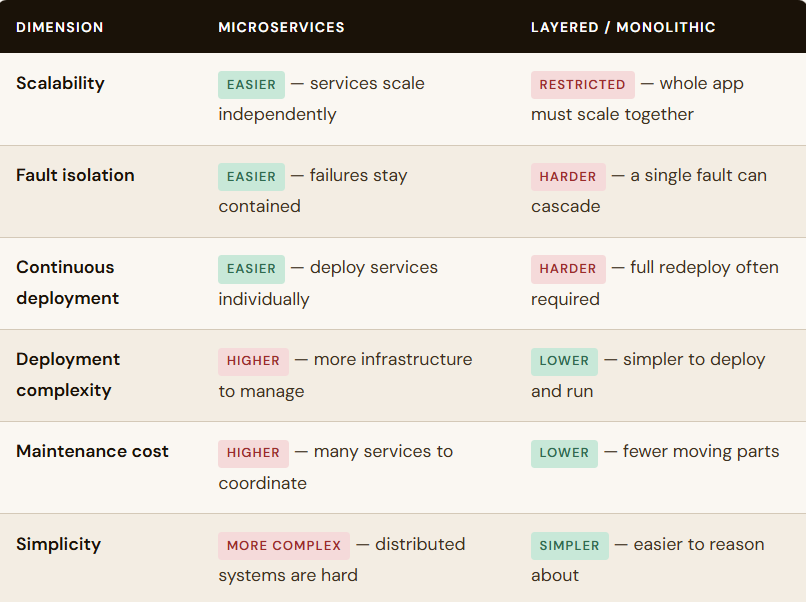
The secret isn't choosing one over the other.
The secret is understanding when each makes sense.
Senior engineers don't memorize architectures. They learn how to evaluate trade-offs.
Key insight for African developers
There is no universally correct architecture. The right choice depends on the problem. System design training teaches developers to reason through that choice and defend it with evidence.
AI is making developers faster, not replacing system design
The rise of AI coding tools has made some developers wonder whether deep technical skills will still matter in the future. After all, if AI can generate code in seconds, why spend time learning system design?
The answer is that AI and system design solve two very different problems.
Research shows that AI tools can significantly improve developer productivity, especially for repetitive or straightforward tasks. They are excellent at generating boilerplate code, explaining concepts, and accelerating development workflows.
However, their effectiveness decreases as projects become more complex. AI can write functions, but it still struggles with architectural thinking. It cannot reliably break down ambiguous business problems, make nuanced trade-offs, or anticipate how a system will behave years into the future.
Developers who understand how to decompose problems and integrate multiple solutions will continue to have a significant advantage, even in an AI-driven world.
What this means in practice
AI can write a function. AI struggles to architect a system. The developer who understands how to decompose a complex problem and integrate solutions across components will always outperform the one who relies solely on AI-generated output.
This is particularly relevant for African developers competing for senior roles. Corporations are not struggling to find people who can write code. They are struggling to find people who can design systems.
Technical Debt: The Hidden Tax on Poor Architecture
Most developers have experienced technical debt, even if they have never formally studied it.
Technical debt happens when teams prioritize quick fixes over sustainable solutions. It might help deliver a feature faster today, but it creates bigger problems tomorrow.
Technical debt sounds scary, but it's something every developer encounters think of it as the interest you pay on rushed decisions !!
Maybe you duplicated code because you were in a hurry.
Maybe you tightly coupled two systems together because it was easier.
Maybe you skipped proper architecture because the deadline was tomorrow.
Over time, these small compromises accumulate and make even simple changes frustratingly difficult to implement.
The compounding risk
The dangerous thing about technical debt is that it compounds. A system built on poor foundations rarely stays the same; it becomes progressively harder and more expensive to maintain. Learning system design is, in part, learning to prevent this from happening.
Why this matters specifically for African developers
Africa has an incredible opportunity ahead of it. The continent is producing technical talent at a remarkable pace, and local startups are attracting more investment than ever before. At the same time, global companies are increasingly hiring remote engineers from across Africa.
But competition is also growing.
Knowing how to build a CRUD application is no longer enough to stand out. The developers who will thrive over the next decade are the ones who can think beyond code and understand how entire systems fit together.
These are the developers who will lead engineering teams, architect products, and solve the kinds of complex problems businesses are willing to pay a premium for.
The gap between a mid-level engineer and a senior engineer is often not the ability to write code faster. It is the ability to make better decisions.
System design helps you develop that skill.
Where to Start: Practical First Steps
If you're just getting started with system design, don't overcomplicate it. You don't need to learn every architectural pattern overnight.
Start by asking better questions every time you build something.
Ask yourself:
How would this system handle growth?
How easy would it be to add new features?
What happens if one part of the system fails?
How would it recover?
These questions are the foundation of architectural thinking.
Then, focus on a few key areas:
Learn the five quality attributes: performance, maintainability, modifiability, scalability, and security. Understand how your design decisions influence each of them.
Study architectural trade-offs: Monoliths and microservices both have strengths and weaknesses. The goal isn't to pick a favourite it's to understand when each one makes sense.
Practice breaking down problems: Before writing code, learn to split large requirements into smaller components. This is one of the most valuable skills you can develop.
Treat technical debt seriously: It's not a cleanup task for later. The decisions you make today determine how easy or difficult your system will be to maintain in the future.
Learn from real-world examples: Pay attention to how successful products are built, why certain architectural decisions were made, and what teams would do differently if they had to start over.
Over time, you will notice a shift in how you approach software development. Instead of immediately thinking about implementation, you will start thinking about design. That shift is often what separates good developers from great ones.
The Bottom Line
Africa does not have a developer shortage. It has a shortage of developers who can design systems, reason about complexity, and build software that can scale.
System design is not an advanced topic reserved for engineers at large technology companies. It is a foundational skill that every developer should invest in early because it influences every application you will ever build.
The developers who will shape Africa's next generation of technology products are not necessarily the ones who write the most code. They are the ones who understand how to build systems that people can rely on.
Because at the end of the day, great developers don't just build features.
They build systems that last
Continue Your Learning Journey...
Building strong systems is a skill that develops with practice and guidance. If you'd like to deepen your skills, explore our programs , where you'll get to learn from and interact with industry professionals who will help you build systems that last.
Visit academy.mctaba for self-paced programs and find the learning path that's right for you.